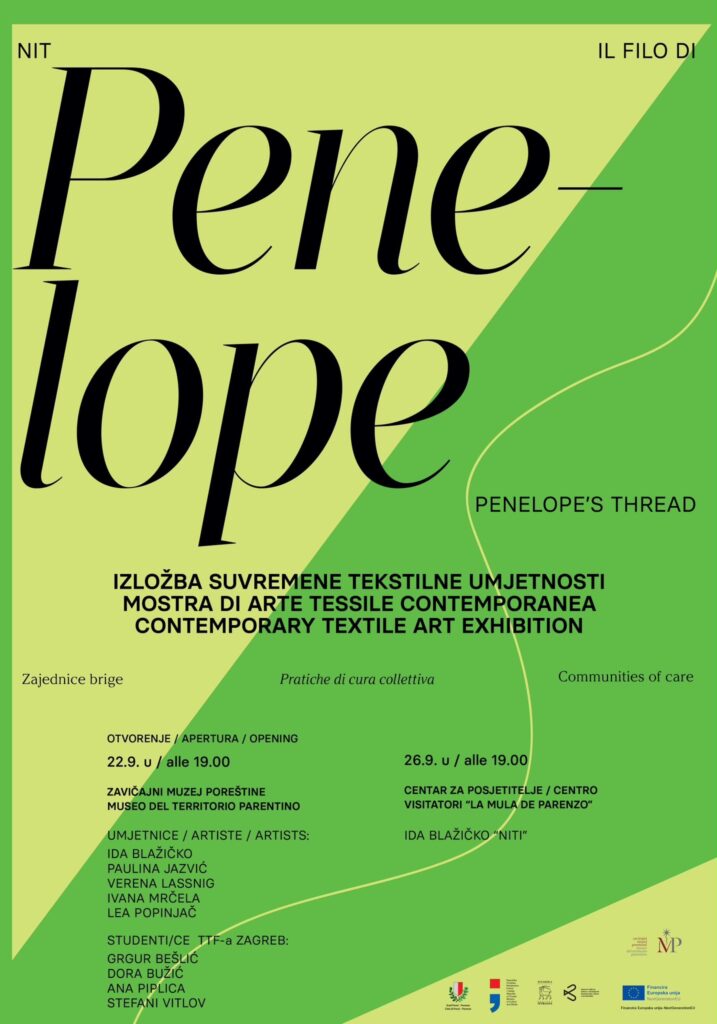
Nit Penelope
/ Penelopes Faden
2026
mit IGEL STACHEL BART · Hand
Gruppenausstellung mit Paulina Jazvić, Ivana Mrčela, Lea Popinjač und Studierenden der Textil-Technologie Fakultät Zagreb
Kuratiert von Sabina Damiani
Ausstellung im Städtischen Museum Poreč, HR
Communities of care: artistic practices of care, togetherness, and resistance
Textile has a long history of connecting people – through shared labor, the exchange of knowledge and tradition, but also through political and social movements. The starting point for this year’s theme is precisely a reflection on how textile can become a medium for visualizing, documenting, or building community.
Every day we face a growing need for spaces in which we can (re)connect with ourselves, our bodies, and our creativity. Support groups that enable this through various techniques are also growing. Art undoubtedly has a positive effect on us, whether we consume it or create it. Working with textile is often presented as an ideal medium for therapeutic effect, and so we see collective gatherings for embroidery, weaving, crochet, and other techniques that encourage reflection and relaxation. Engaging in such practices is experienced as self-care, whether through individual or collective participation. Self-care is not a luxury – it is a practice of respect and compassion toward ourselves, our emotions, needs, and boundaries. When we care for ourselves, we become better and more conscious of the world around us, and thus more capable of caring for our environment and community.
In this context, textile can be viewed as a material of relationships. Its characteristics – softness, flexibility, the ability to bind fibers into a structure – can be understood as a metaphor for social networks, support, and interdependence. Processes such as mending, repairing, or joining different materials can symbolize the restoration of relationships, solidarity, and community resilience.
Through textile work, a care for nature often emerges as well, acting as a co-regulator: enabling calm, reflection, and renewal. This is why we increasingly encounter practices that integrate natural or recycled materials into artistic work, often through encounters that take place in natural surroundings.
Throughout history, women have gathered and worked together with textile. Although this work could be repetitive, even tedious, it allowed women to daydream, process emotions, find comfort in familiar, repeating gestures, and ground themselves while creating something of value, in the company of other women. In a way, through this work they cared for themselves while simultaneously caring for others.
Care is often invisible labor, yet textile is at the same time a powerful tool for shaping cultural identity: textile traditions influence collective memory and healing, especially in times of social or political upheaval. In many cultures, textile work carries not only decorative value but is living heritage passed down through generations, forming an important part of identity. For cultures under various threats – as is the case, for example, with Palestinian culture – it is especially important to preserve and pass on traditional embroidery and weaving methods (tatreez, traditional cross-stitch embroidery whose motifs carry stories of rural origin, marriage, fertility, and resistance), which serve as a living archive of history and stories.
Textile also serves to problematize the network of relationships, practices, and spaces in which people support, protect, and nurture one another. Care can be emotional, physical, social, or political. In this exhibition we present works that consider all these aspects of care, interweaving traditional methods and techniques with contemporary practices.
…
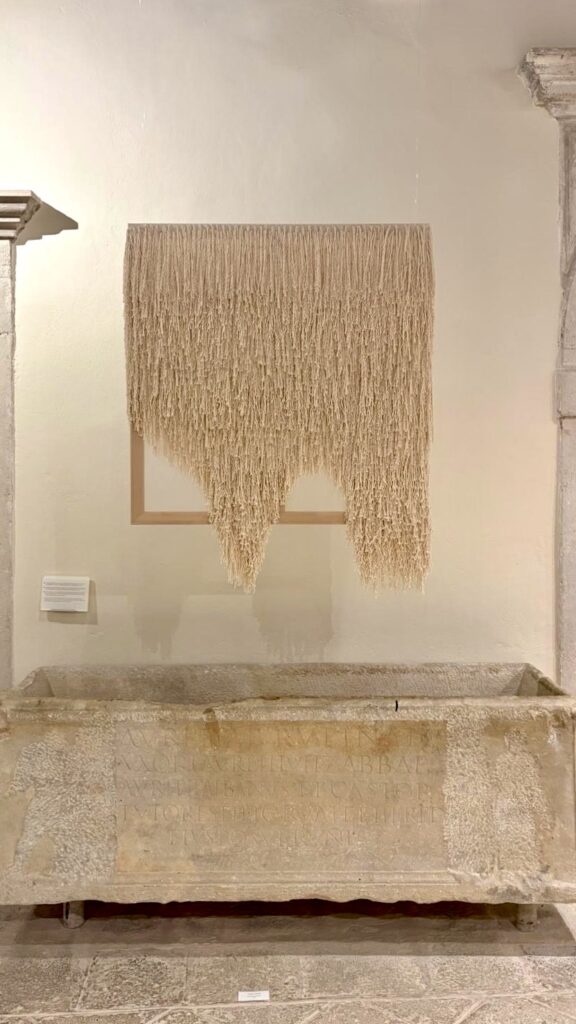
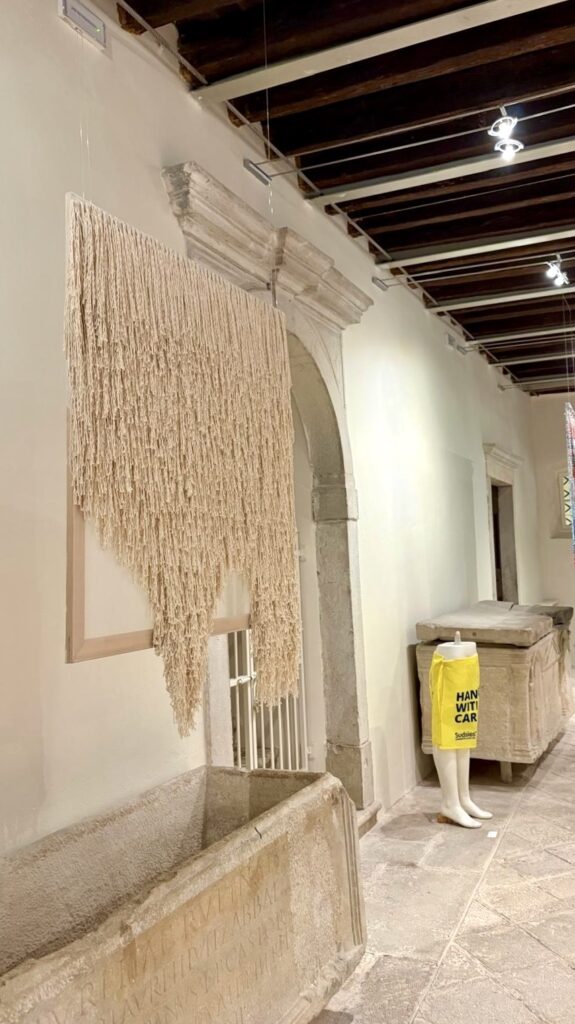
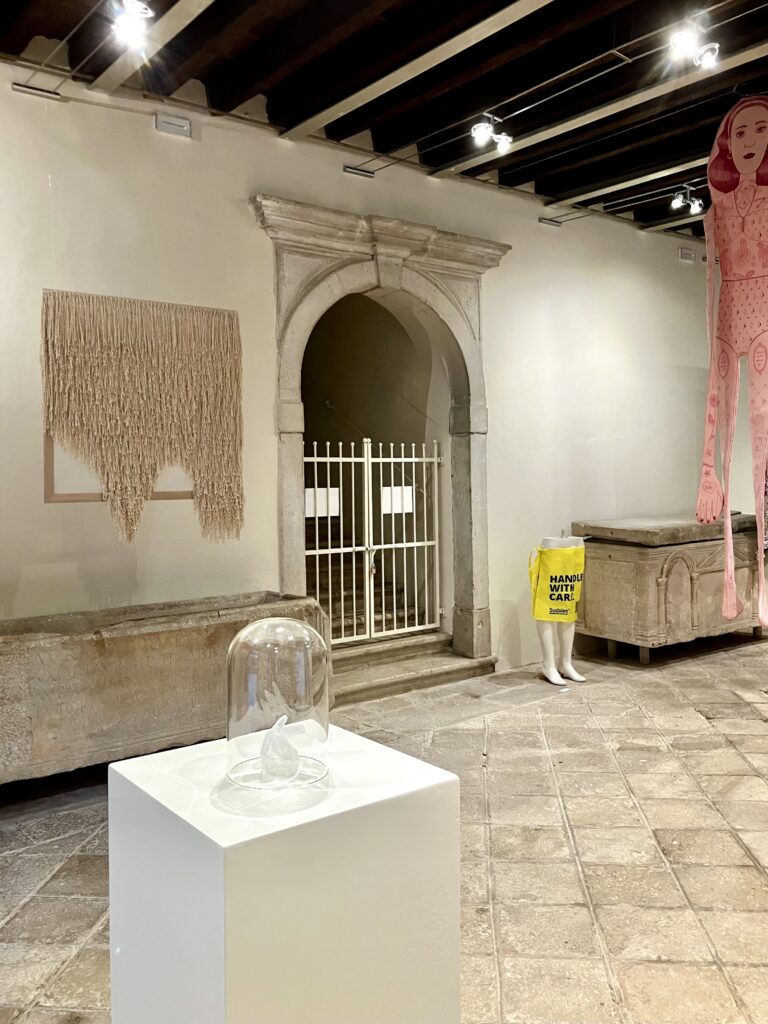
„IGEL STACHEL BART“ is a hand-embroidered, large-format textile picture that explores the extraordinary aesthetic of the bearded hedgehog mushroom (Hericium erinaceus). Verena Lassnig’s fascination with this species, and with the natural world in general, results in carefully sourced organic materials used for the artwork, without the use of plastic or synthetic dyes. In this work we witness a powerful dialogue between nature, the artist, and her craft. It is a call to slow down, to observe the world around us, and to understand creation as a slow, skillful process that takes time and patience – a form of nurture.
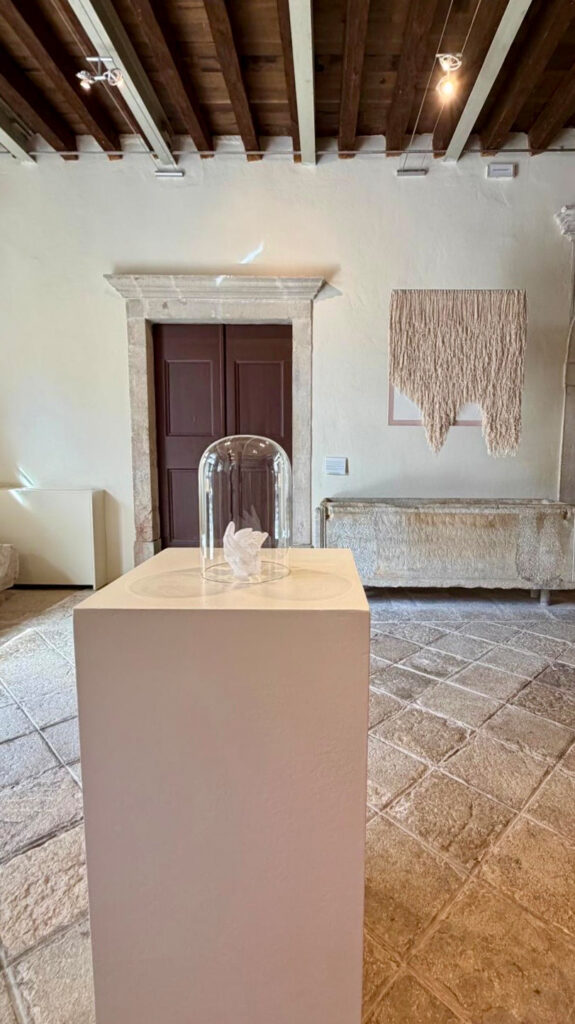
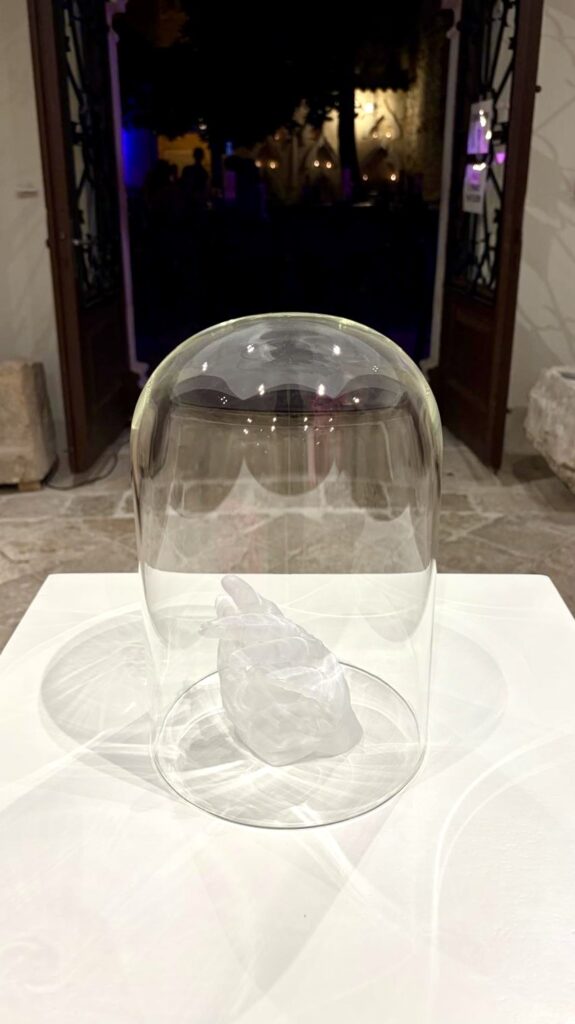
The piece „Hand“ is also made from organic materials (organdy and untreated organic cotton thread). It is a textile life cast of the artist’s left hand, creating a space for reflecting on the means and meaning of artistic practice as a way of taking care of oneself and the world around.
…
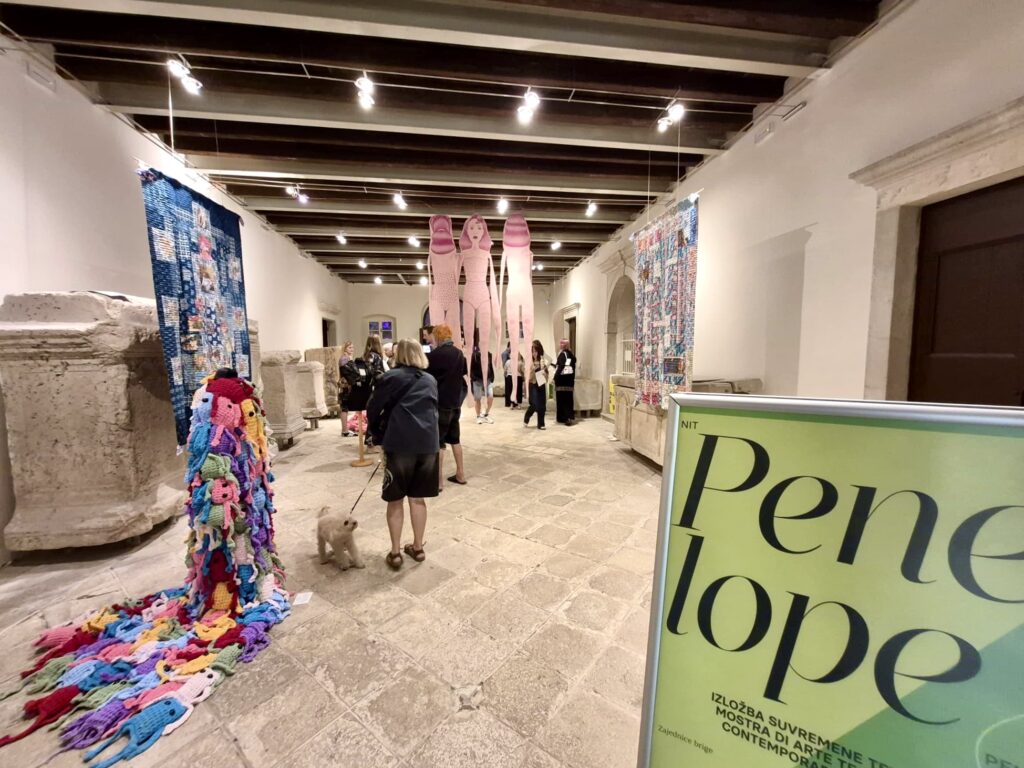
In the work „Offering for Health“, artist Lea Popinjač shapes a kawandi (quilt) as a space of care, togetherness, and spiritual connection. Drawing on a traditional textile technique passed down for generations by women in rural India, the work emerges through a lengthy process of hand-sewing, arranging, and joining fabric fragments into a whole that carries both personal memory and the collective experience of women’s textile work. The quilt was made in collaboration with the artist’s mother, turning the act of sewing itself into a space of intergenerational exchange, shared time, and quiet emotional support. The repetitive movements of hand-sewing, the slowness of the work, and the concentration required to create the kawandi transform the textile practice into a form of meditative care – for another, for oneself, and for relationships that endure through time and absence. The use of long-collected and carefully preserved fine cotton indigo fabrics with hand-printed patterns further emphasizes the importance of imperfection, touch, and handwork. Every visible stitch remains a trace of the time, labor, and attention invested in the process of creation, recalling how textile can be a medium through which communities of care, resilience, and belonging are shaped.
The work „Offering for Creation“ is made using the same technique and in similar dimensions as the previous one, and continues and builds thematically upon it.
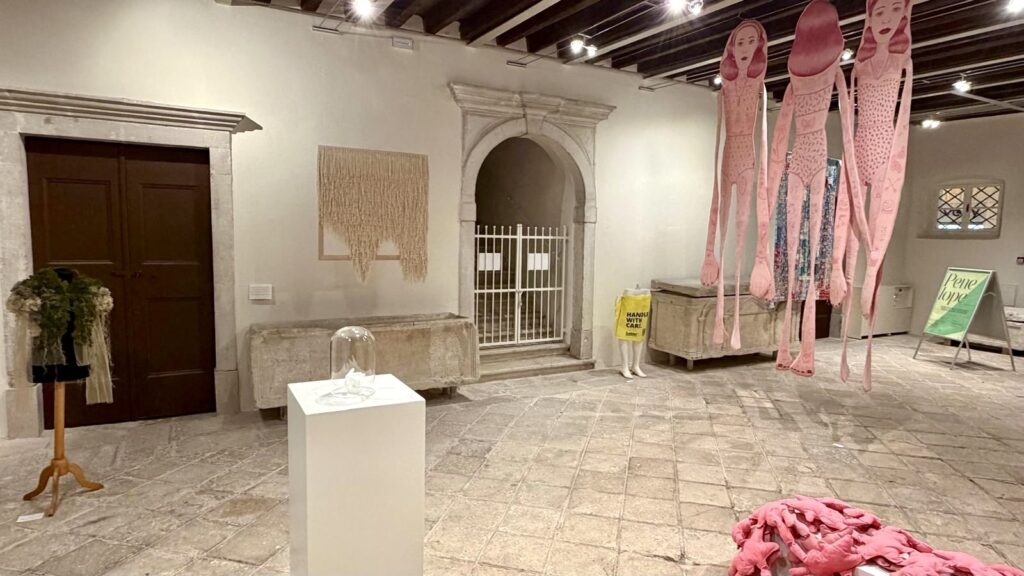
The work „Handle With Care“ by artist Pauline Jazvić takes as its starting point an everyday object whose function is to protect and preserve clothing. A repurposed dry-cleaning bag is shaped into a wearable object that simultaneously functions as a skirt, a protective covering, and a symbolic second skin. The inscription „HANDLE WITH CARE,“ taken from a commercial context, becomes an invitation to reflect on our relationship to human vulnerability and to the labor of care.
Placed on the fragmented body of a mannequin, the object points to the absence of those whose labor remains hidden behind the processes of maintaining and preserving the material world. The work specifically addresses the workers of dry-cleaning establishments and the textile industry, whose care for objects is often socially invisible and undervalued. Through the gesture of repurposing discarded material, „Handle With Care“ links the ethics of care, sustainability, and labor, raising the question of whom and what we grant protection, attention, and value to today.
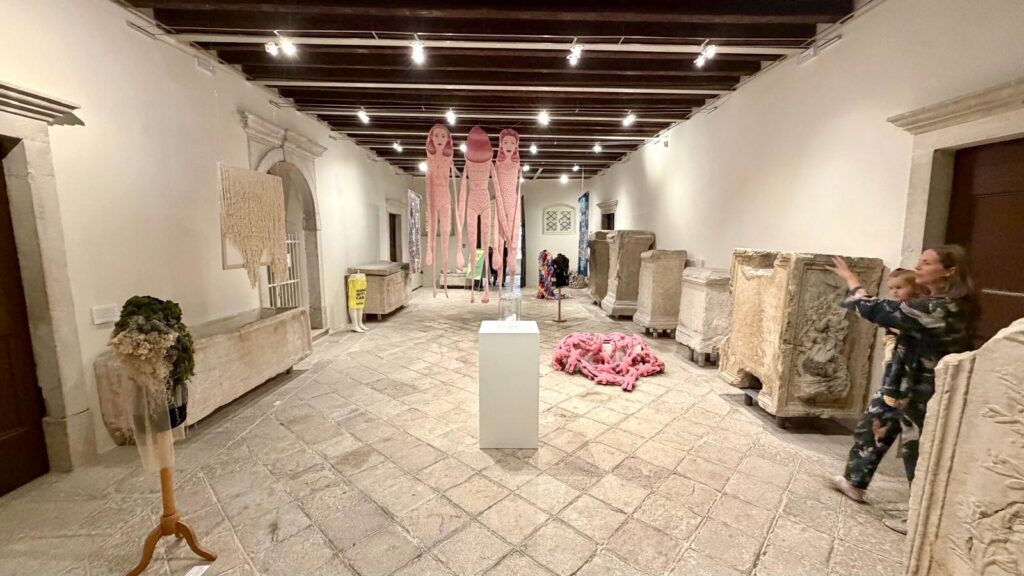
In the work „Naše sestre“ („Our Sisters“), Ivana Mrčela explores female solidarity as a force that has enabled the survival of communities throughout history. The installation speaks of support, the sharing of knowledge and burden, and of the invisible bonds that have connected women’s lives for centuries, even though they are often left out of official narratives. The figures in the installation are intertwined, leaning on one another, creating a visual metaphor for interdependence. None stands alone – stability arises from connection. The work is a tribute to the quiet, invisible forms of women’s labor and care, and also a call to actively practice sisterhood today.
This year’s Nit Penelope exhibition is further enriched by a special collaboration with the Faculty of Textile Technology, University of Zagreb. The works of students and professors (Assoc. Prof. Art. L. Popinjač, Assoc. Prof. Art. I. Mrčela, and Prof. Art. P. Jazvić) were created as part of the research project „Interdisciplinary Methodological and Artistic Perspectives in Contemporary Research on Textile Design and Textile Art (IMPUP-TEX)“, led by Assoc. Prof. Art. Josipa Štefanec (University of Zagreb, Faculty of Textile Technology).
In the work „Body Is Soil“, Grgur Bešlić uses an unconventional material in garment design – moss. It becomes the starting point for his concept, which develops into an exploration of the human body in a state of creative stillness. The body takes on the characteristics of a landscape suited to new growth and creative transformation.
Dora Bužić presents the oversized pillowcase „Bunzzz,“ a work born from the idea of encouraging adults to embrace what is cute – something we abandoned while growing up in order to fit into a corporate society that views cuteness as childish. Bringing cuteness into one’s life is considered a form of self-care, and this work’s task is a quiet, gentle rebellion against corporate burnout.
In the collection „Playground Armor,“ Ana Piplica reflects on the influence of play on early development and on how those same objects and memories take on a new role as we grow up, transforming into an emotional shield and protection in adulthood. Through sculptural forms and distinctive textures, she visualizes the transition from carefree childhood play to an individual’s inner defense mechanism.
In the work „Br. 36“ („No. 36“), Stefani Vitlov explores the potential of discarded materials in fashion design. Collecting old shoes, the artist realized she was gathering not only material for her work but also traces of human journeys. Every sole has its own pattern, and every hole or crack in it speaks to what the person wearing that sole has been through.
We are currently witnessing a revival of textile art, one that is likely not merely a passing trend: in an age of digitalization and speed, it represents a return to craftsmanship, culture, and connection. The work of contemporary textile artists is certainly worth following, to see how textile traditions are being reimagined today.
– Sabina Damiani, Kuratorin